
Mapping the Interior: Introducing the CORE Framework

Share this article:


Organizations routinely burn out their best people by trying to force structural solutions onto readiness problems. They buy new software, draft new strategic plans, and restructure departments, only to watch the same historical dysfunctions reappear months or a year later.
This repetition happens because structural investments primarily address the surface of organizational life. Often, they completely bypass the internal compass that determines whether any investment sticks - that compass being the shared trust a team has in its own collective readiness to act for the sake of a needed change.
To address this specific breakdown, we at EquiVant Strategies developed the Collective Organizational Readiness and Efficacy - or CORE - Framework.
The CORE Framework is a practical methodology designed to help leaders evaluate and strengthen the internal dynamics that determine whether an organizational change sticks. The framework draws from two converging bodies of research:
Organizational Readiness: Dr. Bryan Weiner’s research on why certain organizations successfully carry change forward while others with identical resources do not.
Collective Efficacy: Dr. Albert Bandura’s decades of study into how groups build a shared belief in their own capacity to execute.
Organizations have an interior life that ultimately determines whether external investments yield a true return.
The CORE Framework’s Three Dimensions
The CORE Framework maps this organizational interior across three distinct dimensions.
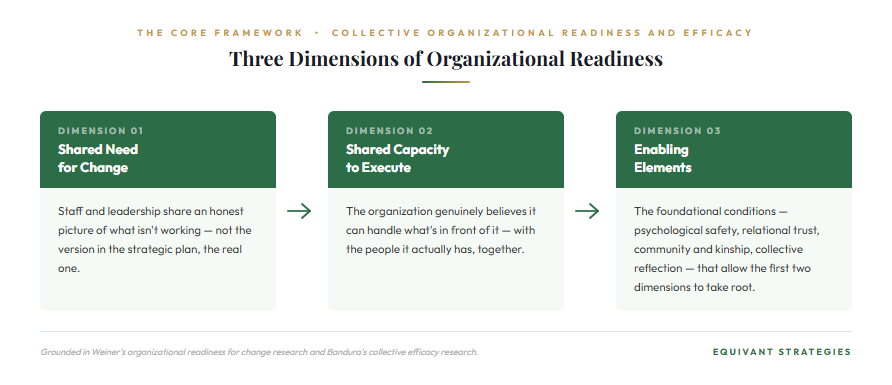
Dimension 01
Shared Need for Change
This dimension measures whether an organization holds an honest, unified picture of its real challenges - not the sanitized version in the strategic plan. Staff and leadership do not need to agree on every solution, but they must diagnose the same problems.
Dimension 02
Shared Capacity to Execute
This dimension focuses on whether a team genuinely believes they can handle the work ahead. This does not require absolute certainty. It requires enough mutual trust to act during uncertainty, and enough resilience to treat friction as useful data rather than proof of failure.
Dimension 03
Enabling Elements
These are the foundational conditions that allow the first two dimensions to take root. They consist of four habits:
Psychological Safety - staff can speak the truth without calculating the career risk first.
Relational Trust - strong, functional connections across different roles and levels.
Community and Kinship - a sense of shared purpose that outlasts any single initiative.
Collective Reflection - the habit of evaluating performance honestly, as a team.
These elements do not generate readiness on their own. They build the environment where readiness can grow and be sustained.
Moving Beyond the Surface
Aligning all three dimensions changes how a team handles pressure. Growth initiatives deliver sustainable results instead of temporary spikes. Hard truths are spoken openly because the relational trust can bear the weight. Shock waves don’t break the team because their capacity to act is anchored internally, not externally.
Leaders routinely fund the visible mechanics of change - things like training sessions, new systems, and strategic initiatives. These investments and capital allocations are necessary to be sure. Yet the CORE Framework forces a deeper reflection:
Do the interior dynamics of your organization support the tools you’re paying for in order to maximize the impact you hope to make?
If the internal readiness isn’t there, the most brilliant strategy on paper will simply sit on a shelf.
You can download the CORE Framework to begin a structured, honest conversation within your team.
When your organization is ready to scale that conversation into an actionable strategy, we at EquiVant Strategies are here to guide the process. We facilitate comprehensive readiness assessments that bridge the gap between your staff’s day-to-day reality and your leadership’s long-term vision - ensuring your next major investment truly takes root.
Ready to map your organization’s interior? Schedule a conversation with our team.
Sources
Weiner, B. J. (2009). A theory of organizational readiness for change. Implementation Science, 4, Article 67.
Bandura, A. (2000). Exercise of human agency through collective efficacy. Current Directions in Psychological Science, 9(3), 75–78.
